加里森敢死队
GT Voice: Chinese investment could help Germany stabilize its talent base_我的网站

一 | 每经记者:张梓桐 每经编辑:余婷婷
“如果过去五年AI(人工智能)的主旋律是‘数字智能’,让机器能看、能听、能说、能画,那么下一个五年的关键命题就是‘物理智能’——让机器能在真实世界中感知、决策、行动。
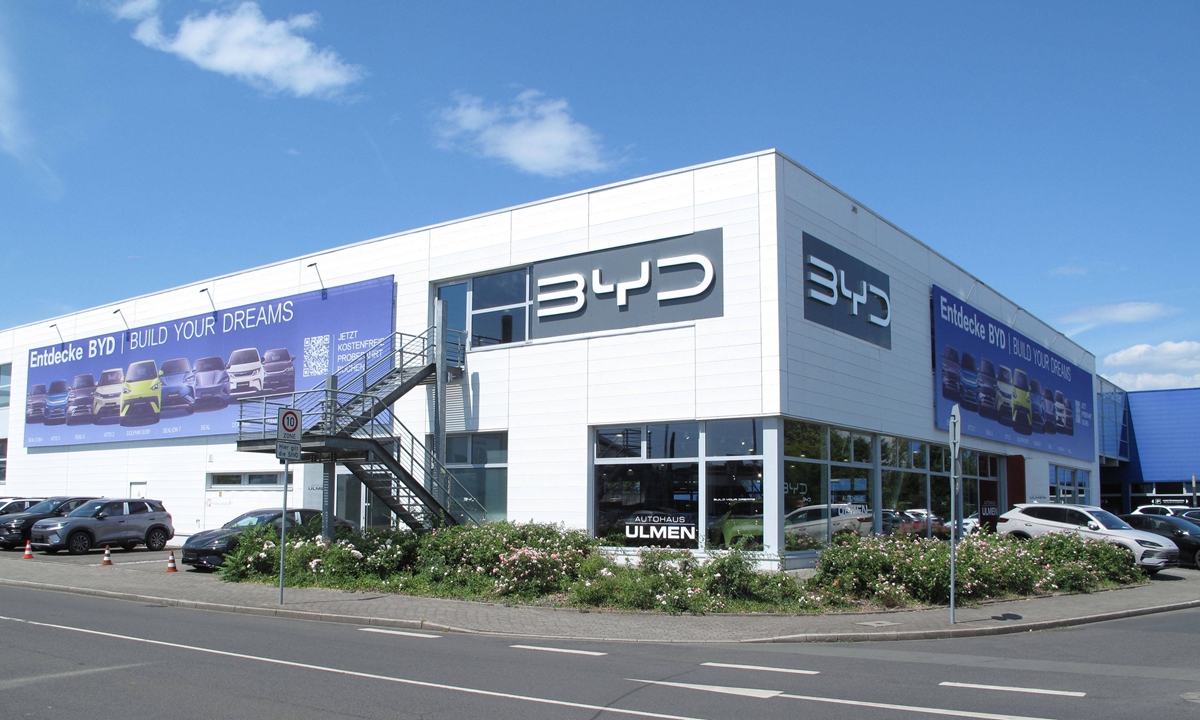
A BYD flagship store at the Ulmen car dealership on H?herweg Auto Mile in Düsseldorf, Germany, with new cars on display out front. Photo: VCG
Germany's industrial woes have increasingly become a hot topic of discussion. The latest Engineer Monitor report from professional association Verein Deutscher Ingenieure and the German Economic Institute offers a new look at the issue.
The report showed that there were 58,392 unemployed individuals in the engineering and information technology (IT) professions in the fourth quarter of 2025, the highest level since the survey began in 2011.
Compared with the previous year, the number of unemployed increased by 16.7 percent, according to German media reports on Sunday.
These figures lay bare the challenges confronting the country's manufacturing sector. The reasons for the industrial woes are multiple. The soaring energy costs caused by geopolitical conflicts, the decline in exports caused by rising protectionism and low external demand, and the structural pain caused by industrial chain restructuring are all squeezing the space of German manufacturing.
Manufacturing is the backbone of Germany's economy, and engineers and IT specialists constitute the core force that sustains this pillar. For decades, the country's reputation for "Made in Germany" excellence was built on the expertise of these skilled professionals. Regardless of the macroeconomic ups and downs, preserving the stability and continuity of its industrial talent pool represents a strategic bottom line for Germany.
Should large numbers of highly skilled technical professionals leave the industry or sit idle, industrial research and development (R&D) and production cycles will be disrupted. Over the longer term, such a waste of human capital will erode Germany's industrial innovation capacity and, ultimately, undermine the foundations of its global competitiveness.
In this context, the urgent task for Germany is to create sufficient quality positions for its technical talent. Should it fail to do so in the short term, then Germany needs to embrace a more open‑minded development approach. Shoring up its manufacturing base cannot be achieved solely through protecting domestic companies; it also requires a significant expansion of effective investment to create enough high‑quality jobs that can attract and retain skilled talent.
This is exactly where China‑Germany cooperation could deliver tangible results. According to the FDI Report 2025 published by Germany Trade & Invest (GTAI), the total number of foreign investment projects in Germany fell 9.3 percent overall to 1,564 in 2025. Nonetheless, Chinese companies became the largest source of foreign investment projects in Germany in 2025, overtaking the US for the first time since 2017.
Chinese companies launched 228 investment projects in Germany in 2025, up 14.6 percent year-on-year. More than one in five Chinese investment projects involved production and R&D activities, above the overall average for foreign investment projects in Germany. This is a sign that Chinese firms are deepening their integration into the local industrial base, according to GTAI.
Observers noted the trend, pointing out that China is becoming an important force in driving German re‑industrialization. In industries where Germany urgently needs to rebuild its competitive edge, such as electric vehicles, batteries, energy technology, digital manufacturing, and automation, China is emerging as an increasingly significant complementary partner. In these critical areas that will determine industrial competitiveness in the coming decades, the relationship between China and Germany is not merely one of rivalry; there are clear and substantial complementarities. Germany still boasts world‑leading engineering expertise, precision manufacturing capabilities, and a strategic location at the heart of the European market.
China has complete and highly integrated supply chains for raw materials and intermediate goods and large capacity for increasing production. When Chinese automakers set up R&D centers in Germany, or when Chinese tech firms collaborate with German factories to build smart production lines, the beneficiaries are not only the Chinese companies but also the German engineers who would otherwise face redundancy.
Cross‑border investment cannot flourish without a sound policy environment. Chinese companies are apparently willing to develop in Germany, but it can only happen on the premise that the German side provides a fair, reasonable and predictable business environment, reduces non-market interference in commercial activities, and allows capital to operate in accordance with market rules.
If the two countries are able to reach a deeper level of cooperation in investment, many of Germany's trade‑related concerns may well find more pragmatic solutions. The deep integration of industrial value chains would facilitate two‑way trade, creating renewed momentum for German exports of machinery, vehicles, chemicals, and other competitive products to China.
。”7月19日,网易灵动总经理杨新伟在接受《每日经济新闻》专访时如是说。
2026世界人工智能大会(WAIC)上海世博展览馆内,网易灵动展区的远程智控平台前,参观者络绎不绝。座舱内,一名工作人员手握方向盘,拇指悬在红色急停按钮上方,分屏画面里机械铲斗正在煤堆间精准起落——切入、翻转、卸料,整套动作行云流水。他正跨越千里,远程操控真实电厂、港口的生产一线设备。
图片来源:企业供图
这是网易灵动集中展现具身智能规模化落地高危场景的一个缩影。近年来,网易一方面继续深耕创造稳定收入的传统游戏业务,另一方面重仓仍在高速“烧钱”但具备实体产业渗透潜力的具身智能基础设施。
5月21日,网易2026年一季报披露,当期研发支出约45亿元;另据2025年年报统计,2020年至2025年,网易已连续六年研发投入突破百亿元。对网易而言,传统游戏、具身智能基建并非孤立的布局。把时间线拉长,这是一家市值超6000亿港元、以游戏和内容见长的互联网公司,在同一个技术底座上完成的战略转身。
跨界底气:游戏是AI最有效的试验场
从游戏到工程机械,这条跨界之路在外界看来充满跳跃感。杨新伟告诉记者,网易并非凭空跨界,“在互联网大数据、游戏AI、工程机械具身智能这些领域,跨界可以带来足够的创新和思维的碰撞”。
他向记者强调了一个常被忽视的事实:“游戏一直是AI技术最有效的试验场。”从IBM深蓝(IBM研发的专用国际象棋超级计算机)到AlphaGo(阿尔法围棋),AI在游戏中取得突破后再迁移到真实世界,这是被反复验证的路径。“网易做具身智能不是凭空跨界,而是沿着这条路径在走。”杨新伟说。
据杨新伟介绍,网易使用爆款游戏《逆水寒》同款的渲染引擎和管线搭建仿真环境,能在虚拟世界里低成本、高保真地生成作业场景,让算法先在仿真中学习和训练再迁移到实机。
但飞轮要转起来,光靠仿真不够,还需要高可靠的工程化能力。“游戏业务对可靠性要求极高——千万级并发下不能崩,这和工程机械的工业级可靠性,在工程文化上是相通的。

二 | ”杨新伟认为,技术如果停留在实验室只能叫做Demo(演示),能扛住产线连续运转才叫产品。“这一层和数据飞轮是一体的——没有工程化能力,仿真到实机的闭环根本跑不起来。”
完成仿真环境搭建、补齐工程化落地能力后,网易还实现了整套AI训练方法论的跨行业迁移复用。

三 | “我们最早的版本,直接使用了《永劫无间》的模仿学习框架,让老师傅在模拟器里操作,算法跟着学。

四 | ”杨新伟告诉记者,这套从游戏里搬过来的行为克隆方法,用在工程机械操作技能学习上,训练收敛速度提升了50%。

五 |
“这不是简单的技术复用——我们用数据证明了游戏AI的方法论,真的可以迁移到具身智能。

六 | 这个验证做完,团队内部才彻底相信:我们选的路走得通。”杨新伟说。
依托游戏技术打通工程机械具身智能落地路径后,网易灵动将目光投向港口无人化赛道。业内已有玩家在水平运输场景实现规模化落地,网易灵动为何选择“散货清舱”这一垂直场景切入?“水平运输和散货清舱看起来都在‘港口无人化’这个大框里,但本质是两类技术问题。

七 | ”面对记者的疑问,杨新伟表示,水平运输是移动机器人问题——核心是导航、调度、车队协同,难点在规模化和系统集成,技术栈相对成熟。

八 | “散货清舱是作业机器人问题——核心是非结构化环境下的操作。船舱里物料形态随机,抓取路径、力度、策略每秒都在变,这不是路径规划能解决的,而是感知—决策—执行的闭环。这类场景技术天花板更高,也更难被快速复制。”
至于未来是否会向港口全链条延伸,杨新伟的回答务实而克制:“我们不排除横向拓展的可能性,但本质上仍然要把有价值的事情做好做透。”
生态定位:与主机厂互补,做“能力放大器”
值得一提的是,港口、矿山无人化赛道虽已出现规模化玩家,但行业落地高度集中于水平运输、矿卡自动驾驶等结构化场景,技术门槛相对偏低,市场同质化竞争加剧。因此,在采访中,杨新伟向记者反复强调网易灵动的生态定位——不做硬件,做“大脑”。
图片来源:网易灵动公众号
“我们与工程机械厂家是互补生态位——他们有机械、渠道、客户信任,我们有仿真、算法、迭代速度。

九 | ”杨新伟认为,“这种定位让我们避免与主机厂正面竞争,成为他们的能力放大器,一起为客户、为社会创造价值。”
这一理念在本届WAIC的展台上得到了具象化呈现。

十 | 网易灵动将“智能座舱”搬入展区,工作人员远程操控电厂、港口的生产一线设备;而在千里之外的内蒙古霍林河北露天煤矿,网易“灵掘”挖掘机器人单机装车效率已达熟练人工的80%,近70%作业时间无需人为干预,可以适配极寒、高粉尘等严苛环境与多型号设备。
“中国不缺工程机械供应商,但缺能啃下智能化硬骨头的团队。”杨新伟向记者强调,正是基于这一判断,网易灵动选择开放部分数据,推动行业生态共同繁荣。
“行业预测无人矿卡即将迈入万台规模化节点,这也标志着第一步产业培育成熟——矿山客户已经充分认可无人装备的安全、人力、能耗优势,采购预算、运维体系、政策配套全部到位。

十一 | ”杨新伟表示,无人挖掘设备掌控整体开采效率,是矿山产能核心。
从《逆水寒》的虚拟江湖到千里之外的煤堆船舱,游戏AI与工业具身智能的跨界打通,印证了数字智能向物理智能跃迁的可行路径。当下矿山、港口无人化赛道同质化竞争愈演愈烈,不少厂商扎堆硬件制造、争抢标准化场景,网易灵动选择“只做大脑、不造设备”的差异化定位,试图走出一条与主机厂共生而非对抗的落地路线。
当水平运输等规模化场景逐步成熟,散货清舱、露天挖掘这类高度依赖实时感知、动态决策的作业场景,将成为下一阶段产业竞争的新焦点。
每日经济新闻。
Current article:http://www.cousizhegaobaolengkuo.bond/bqaksgi/y09b.docx
Published on:01:39:38


