
重庆森林
Chinese-made infrared telescope with domestic detectors achieves astronomical imaging, reducing foreign reliance_我的网站

一 |

China opposes illegal unilateral sanctions that have no basis in international law and are not authorized by the UN Security Council, a spokesperson of the Chinese Foreign Ministry said on Friday, calling on relevant parties to act responsibly and seek a solution through political and diplomatic means.
Chinese Foreign Ministry spokesperson Lin Jian made the remarks at the regular press briefing when asked to comment on US Treasury Secretary Scott Bessent's remarks that the US would impose "the toughest sanctions in history" on Iran and urged China to cooperate with it.
At the same press briefing, in response to another question regarding US sanctions on Iran, Lin said China has consistently maintained that military means, sanctions and pressure are not conducive to resolving the issue. Instead, they will only heighten tensions and escalate the situation, which serves no party's interests.
"We call for differences and disputes to be resolved through dialogue and consultation," Lin stressed.
Global Times
。
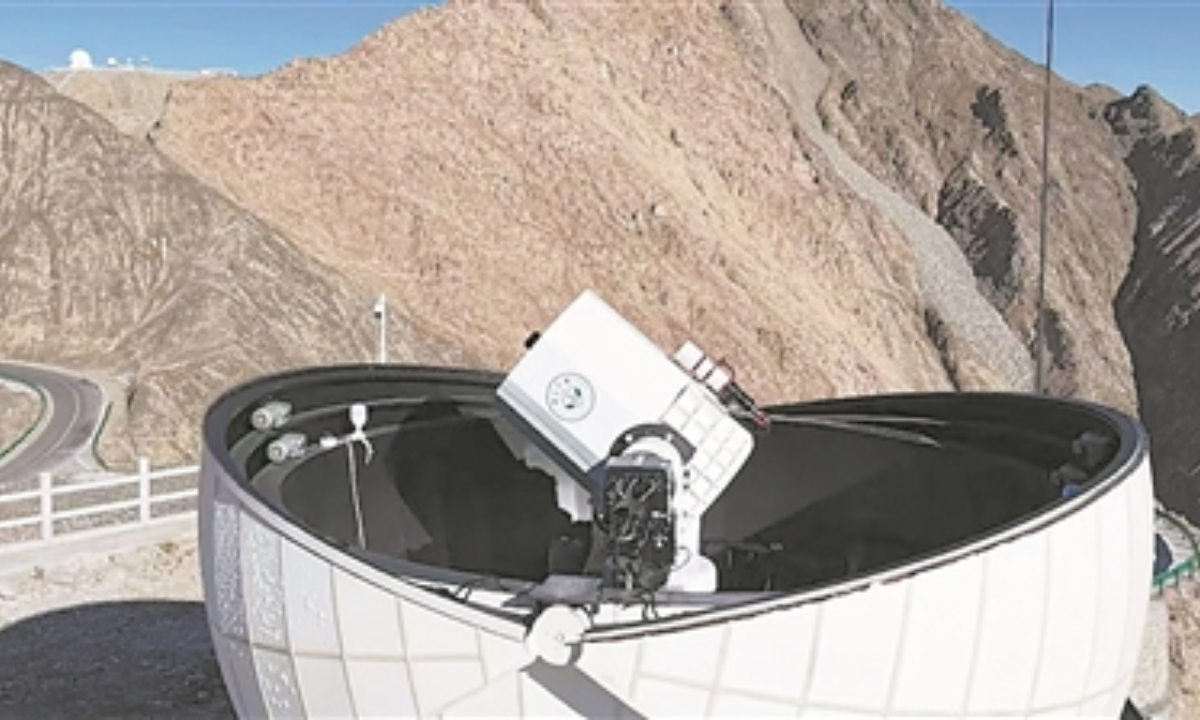
Chinese scientists on Wednesday released the first complete set of observational images captured by China's new-generation ground-based infrared telescope, filling a gap in the country's near-infrared astronomical observation capabilities and reducing reliance on foreign infrared detector technology, China News Service reported on Wednesday.
The 80-centimeter near-infrared telescope was installed at Saishiteng Mountain, Lenghu township, Northwest China's Qinghai Province in October 2024. Jointly developed by Sun Yat-sen University and several partner institutions, the telescope is China's first to achieve scientific imaging in the 1.2-micrometer J band and 2.2-micrometer K band using domestically developed scientific-grade InGaAs and HgCdTe detectors.
The telescope enables unattended remote operations, and can lock onto any target in the sky within 15 seconds. Its infrared capability allows it to see through interstellar dust, enabling it to observe cold and distant celestial objects that are difficult for optical telescopes to capture.
According to Ma Bin, a professor at the School of Physics and Astronomy, Sun Yat-sen University who led the research team that released the infrared telescope's observational images, all three of the telescope's core astronomical observation capabilities were fully validated during operation.
It rapidly responded to and tracked multiple gamma-ray bursts and supernova events, recording the evolution of their infrared afterglows following the explosions. It continuously monitored brown dwarfs, precisely capturing periodic variations in their atmospheric brightness. Using image-stacking technology, it also observed active galaxies billions of light-years away.
Since its deployment in Lenghu, the system has supported infrared observations for more than 10 Chinese research institutions, accumulating valuable experience for the construction of future large-scale infrared telescopes.
Lenghu township, where the world-class astronomical observation base takes shape, is hailed as "the most Mars-like place on the Earth." The astronomical observation base was said to be an astronomical observation site comparable to the top ones in the world by a Nature article published on August 18, 2021, according to the Chinese Academy of Sciences.
Once prospered in 1950s due to its rich petroleum resources, Lenghu is now becoming a premier astronomical observation site and Mars-themed tourist destination, according to Xinhua News Agency.
Global Times
。
Current article:http://www.cousizhegaobaolengkuo.bond/e7u2wf/ukunqkr.html
Published on:14:54:55