极盗车神
Wang Xiji, pioneer of China's space program, dies at 105_我的网站

A | (ECNS) -- Wang Xiji, one of the pioneers of China's space program, an academician of the Chinese Academy of Sciences, and recipient of the "Two Bombs, One Satellite" Meritorious Service Medal, died in Beijing on Wednesday at the age of 105 after an illness. The China Academy of Space Technology said his death was a great loss to China's space program, expressing deep condolences and remembrance for the scientist who devoted his entire life to the country's aerospace endeavors. In November 1958, shortly after the launch of the call that "we should also develop artificial satellites," Wang was transferred to the Shanghai Institute of Mechanical and Electrical Design under the Chinese Academy of Sciences, where he became the technical leader for sounding rockets. At the beginning of the project, working conditions were extremely rudimentary. The team had no experience, reference materials or experts, and had to start from scratch. With only hand-operated calculating devices available, several team members worked day and night for more than two months to calculate a single flight trajectory. With no launch site, they used a rice paddy on the outskirts of Shanghai as a makeshift launch pad. They hoisted the rocket onto its launch stand with a winch and pressurized the propellant using a hand pump. On Feb. 19, 1960, Wang and his team successfully launched China's first sounding rocket, the T-7M, from the rice field. Although the rocket reached an altitude of only 8 kilometers, the launch marked a crucial first step in China's journey into space. During the subsequent development of the Long March-1 rocket, Wang innovatively integrated technologies from sounding rockets and missiles. He formulated the technical plan for Long March-1, China's first satellite launch vehicle, and led the development of its overall design and prototype. His work laid an important foundation for the successful launch of China's first satellite. In February 1968, Wang joined the newly established China Academy of Space Technology and continued to devote himself to China's space program. On April 24, 1970, China successfully launched its first artificial Earth satellite, Dongfanghong-1, into space aboard a Long March-1 rocket, becoming the fifth country in the world to independently launch a satellite into orbit. On Nov. 26, 1975, China successfully launched its first recoverable satellite. While the nation celebrated the successful launch, Wang hurried to the satellite tracking and control center, knowing that the mission would not be considered a complete success until the satellite returned safely to Earth. He stayed awake for three days and three nights. Only when he saw the red-and-white parachute appearing in the sky did he finally relax. The successful recovery brought back China's first batch of high-resolution remote-sensing film covering the country, providing basic data for national land surveys, topographic mapping and other applications. China thus became the third country, after the United States and the Soviet Union, to master recoverable satellite technology. Wang said he felt the main meaning of life lies in participating in the great cause of socialist construction and contributing his share to it. "I understand the cause of the Party and have made up my mind to strive to become a Communist," Wang wrote in his application to join the Communist Party of China. He remained committed throughout his life to his belief that "one should strive to be a Communist," and honored his lifelong pledge: "I am willing to be a paving stone for space." (By Gong Weiwei) 
 。
。
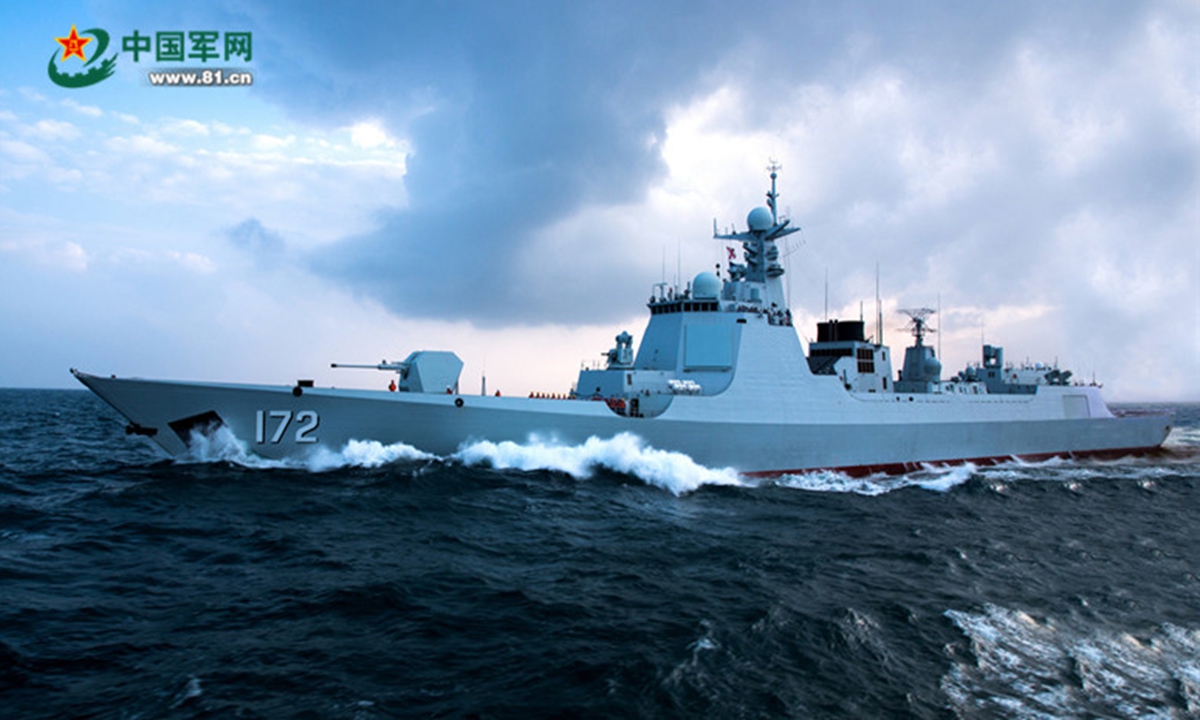
An image of PLA Navy's guided-missile destroyer
Kunming (Hull 172) Photo: China Military Online
The Chinese People's Liberation Army (PLA) Navy's 49th escort taskforce set sail from a military port in Sanya, South China's Hainan Province on Wednesday, heading for the Gulf of Aden and waters off Somalia to relieve the 48th escort taskforce and continue escort missions, according to the Xinhua News Agency.
At around 10:30 am, the taskforce vessels cast off and slowly departed from the pier. On deck, the escort personnel stood in crisp formation, waving farewell to their families and the motherland, Xinhua said.
The 49th escort taskforce is composed of naval forces from the PLA Southern Theater Command, including the guided-missile destroyer
Kunming, the guided-missile frigate
Yueyang and the large far-sea comprehensive supply ship
Luomahu, with two shipborne helicopters and dozens of special operations personnel aboard. All three vessels were independently designed and built by China, with the
Kunming undertaking an escort mission for the first time, said Xinhua.
According to a CCTV News report, China's first Type 052D destroyer, the
Kunming, entered service with the PLA Navy on March 21, 2014. The vessel possesses strong regional air defense and anti-surface warfare capabilities.
During the mission preparation phase, the task force command post closely monitored the potential risks, challenges and actual threats that the escort mission might face. In accordance with the requirements of full-element combat-oriented training, the taskforce conducted targeted training including live weapon exercises, accompanying escort and underway replenishment, Xinhua reported.
China's Ministry of National Defense said on Tuesday that the PLA Navy is committed to building and supporting a maritime community with a shared future and contributing to the security of global sea lanes as well as regional peace and stability.
In line with relevant UN Nations Security Council resolutions, China has maintained a regular naval escort presence in the Gulf of Aden and waters off Somalia since 2008 to safeguard the security of international shipping routes, escorting over 7,000 Chinese and foreign vessels and rescuing, protecting or assisting ships in distress, Xinhua said.
The naval ships also participated in evacuations of Chinese citizens and foreign nationals from some war-torn countries, the report said.
According to a video released by CCTV on Wednesday, the Type 052D destroyer, the Tangshan, part of the PLA Navy's 48th escort taskforce, is still docked at the base in Djibouti. Since being deployed for escort missions on October 11, 2025, the 48th escort taskforce has now been on duty for nearly a year, a sustained deployment.
Global Times
。
Current article:http://www.cousizhegaobaolengkuo.bond/jfaied5/20260826/5347.xlsx
Published on:14:00:30





 发表于 12:03:27

 。
。  QQ好友和群
 QQ空间
QQ空间 腾讯微博
腾讯微博 腾讯朋友
腾讯朋友 收藏
收藏 支持
支持 反对
反对
 发表于 06:01:05


