国内我的网站主页 > 我的网站国内 >
摘要:天网...

独立日

Chinese, Belarusian airborne troops launch Swift Eagle drill_我的网站

戏说乾隆

一 |     

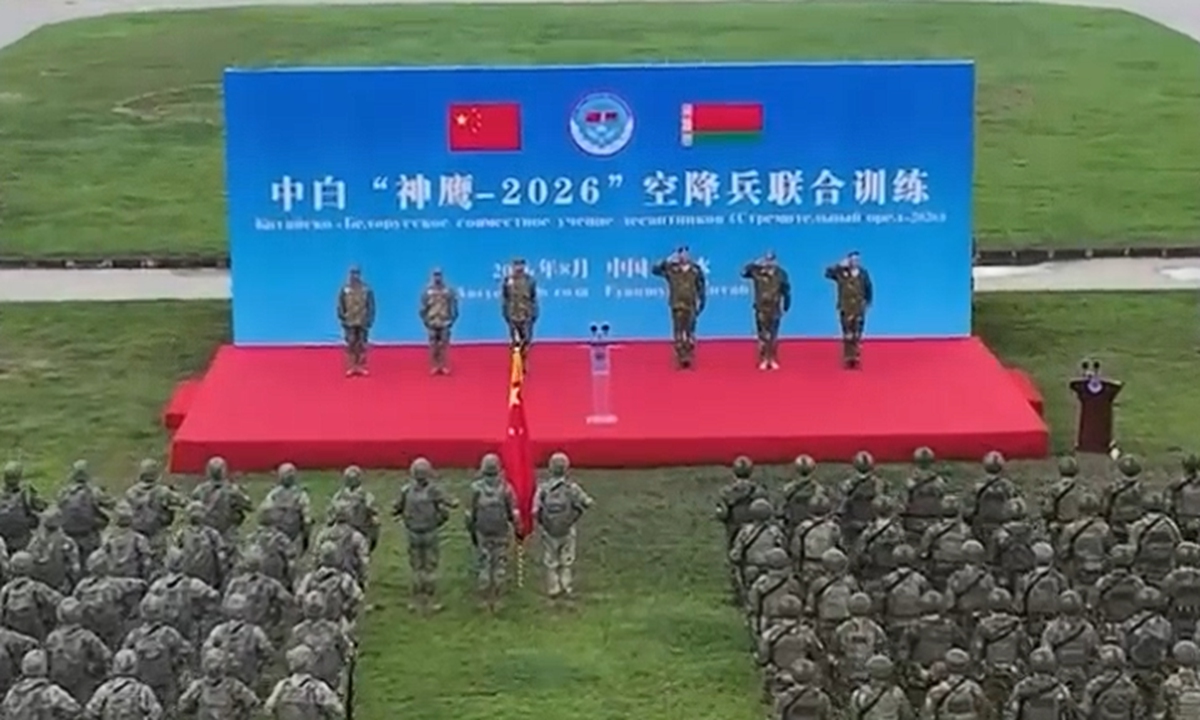
Airborne troops from China and Belarus take part in the opening ceremony for the Swift Eagle 2026 joint training exercise at a Chinese People's Liberation Army (PLA) Air Force training center on August 12, 2026. Photo: Screenshot from PLA Air Force Sina Weibo account
    Airborne troops from China and Belarus take part in the opening ceremony for the Swift Eagle 2026 joint training exercise at a Chinese People's Liberation Army (PLA) Air Force training center on August 12, 2026. Photo: Screenshot from PLA Air Force Sina Weibo accountThe Swift Eagle 2026 joint training for airborne troops from China and Belarus commenced on Wednesday with an opening ceremony at a Chinese People's Liberation Army (PLA) Air Force training center, according to the Xinhua News Agency.
Focusing on "joint counter-terrorism operations in urban terrain," the training will focus on subjects such as surveillance and counter-surveillance, seizure-and-control and protection, and elimination and defense, Xinhua reported.
In addition, the two sides will organize seminars, friendly football matches and cultural exchange activities during the joint training, said the report.
As the fourth iteration, the joint training will help enhance the combat capabilities of the participating troops and deepen substantive cooperation between the two militaries, said Xinhua.
While details on the equipment deployed by both sides have not yet been disclosed, Wang Yanan, editor-in-chief of Beijing-based Aerospace Knowledge magazine, told the Global Times on Thursday that Belarus is likely to follow its traditional practices, focusing on low-altitude small-scale airborne operations, possibly using Il-76 large transport aircraft, while China may deploy Y-9 or Y-20 transport aircraft for low-altitude delivery.
The joint training is not a one-way learning exercise, but rather a process of building a cooperative foundation and familiarizing both sides with each other's operational habits in the counter-terrorism domain, Wang said.
While China has made significant progress in counter-terrorism and maintaining stability in recent years, the expert said, airborne troops have been rarely used in counter-terrorism operations, as local police and armed police forces are generally sufficient to handle such situations.
Airborne troops are better suited for special counter-terrorism scenarios, such as large-scale counter-terrorism operations or cases where terrorists have occupied urban building complexes and need to be forcibly removed. This joint training likely simulates such scenarios, Wang said.
The previous iteration of the Swift Eagle series airborne joint counter-terrorism training between China and Belarus took place in 2015.
In June 2015, a PLA Air Force spokesperson announced that China had dispatched an airborne special operations detachment to Belarus to participate in the Swift Eagle 2015 joint counter-terrorism training. 
According to China Military Online, the training followed the 2011 and 2012 joint exercises between the two countries' airborne forces, again focusing on joint counter-terrorism operations.
The spokesperson noted that Belarus is a traditional friendly country to China. 
Conducting joint airborne training with Belarus helps consolidate traditional bilateral friendship, deepen practical exchanges and cooperation between the two militaries, and enrich the content of the comprehensive strategic partnership between the two countries.
Wang noted that Belarus, located to China's west, and China share a common long-term interest in discussing counter-terrorism. 
After a hiatus of several years, the resumption of the Swift Eagle joint training provides an opportunity to promote in-depth cooperation in defense and mutual trust, serving as a point of common interest for both sides.
Wang noted that the PLA's domestic training exercises have undergone profound changes in recent years.
For example, the documentary series Zhìshèng (Victory) broadcast in early August, showed training conducted with a no-script model, with both sides engaging in free-form confrontations and evaluating results based on actual combat performance, promoting the integration of personnel and equipment systems to generate new operational capabilities. This model has already produced notable results.
More broadly, Wang said, recent joint exercises between the PLA Air Force and foreign militaries have yielded multiple benefits, primarily on two levels. 
First, they lay the groundwork for potential future joint operations, whether in counter-terrorism, maintaining stability or major international security issues, as mutual familiarity is essential for effective cooperation.
Second, joint exercises themselves contribute to regional stability. When friendly countries in the region reach consensus on security issues and conduct regular military cooperation, it has a stabilizing effect on regional security. 
Overall, the PLA is building a more open and flexible military cooperation framework through both enhanced domestic combat-oriented training and expanded international joint exercises, Wang said.

二 |     Ahead of director Priyadarshan nearing the remarkable milestone of 100 films, Filmfare's Editor-in-Chief Jitesh Pillaai reflects on the filmmaker’s unmatched legacy, especially in Malayalam cinema and why the maestro deserves to be celebrated much more.          In his words:     Kilometers of Laughter: A Journey Through Priyan’s World     He is on his century—that is 100 films old. I think he is currently batting on 99. Inching close to seventy years of age, Director Priyadarshan has celebrated enough. He should be toasted for his style and his Malayalam body of work. Cine goers of a certain vintage remember him for his sharp comedies, including his debut Poochakkoru Mookkuthi. He paid tribute to Sai Paranjpye with Odaruthammava Aalariyam (inspired by Chashme Buddoor) and Mukunthetta Sumitra Vilikkunnu. He rehashed several Malayalam films like Ramji Rao Speaking, Kireedam, and Punjabi House to give us a slew of Hindi bonanzas like Hungama, Hulchul, Gardish, and of course, the rib-tickling Hera Pheri.                    Priyadarshan brought spit and polish to Malayalam movies with technical marvels like Kaalapani and Kanchivaram. The team of Mohanlal and Priyadarshan gave us a slew of classics: Kinnararam, Kilukkam, Thenmavin Kombath, Chandralekha, and Mithunam. Films like Mazha Peyyunnu Maddalam Kottunnu, Kilukkam, and Thenmavin Kombath reach "iconic" status with every passing year.     What makes the familiar and time-tested Priyadarshan tropes so warm and all-embracing? He gave comedy a mad, zany world appeal. He humanised comedians and gave them an afterlife. Whether it was Vellanakalude Nadu or Adwaitham, Priyadarshan showed us life’s foibles; he showed us how a unique strength lies within our dysfunctional families and their frailties. With a master craftsman like Mohanlal helming his ventures, you could not go wrong.          You may recall the Priyadarshan of Bhool Bhulaiyaa and Bhagam Bhag, but he is more than all of that. He redefined comedy and rewrote the rules of drama. He mocked filmmakers ever so gently and turned the rules of filmmaking topsy-turvy. Watch that one scene in Boeing Boeing where a three-timing Mohanlal is trying to hide his three girlfriends in different rooms; it is a hoot. That scene was later re-enacted in Garam Masala by John Abraham and Akshay Kumar.          To reduce Priyadarshan’s oeuvre to just comedy is to diminish his legacy. One of my favourite films of his, Dheem Tharikida Thom, about a run-down drama troupe, is a classic. As are Punnaram Cholli Cholli and Thalavattam. Like all great filmmakers, Priyadarshan harnessed the best out of Santosh Sivan, Sabu Cyril, and S. Kumar, alongside his band of wonderful ensemble actors: Nedumudi Venu, KPAC Lalitha, Innocent, Oduvil Unnikrishnan, and Mamukkoya. You have to watch Mithunam to realise his legerdemain and absolute control of his craft.          It would be a pity if Priyadarshan is cited only for his Bollywood outpourings. What he gave to Malayalam cinema was clout, longevity, charisma, and unabashed storytelling. I have lost count of the times I have watched Kilukkam, Vandanam, Mazha Peyyunnu Maddalam Kottunnu, and Poochakkoru Mookkuthi. He makes the absurd believable and the impossible look real.          Priyadarshan is a part of our Malayalam movie memories and our rites of passage. If we cut our milk teeth on Poochakkoru Mookkuthi, we came of age with Vandanam and Kaalapani. I assure you, well into our dotage, we will still be chuckling at the "kilometers and kilometers" joke from Mazha Peyyunnu Maddalam Kottunnu. Like Priyadarshan and his movies, we grew up at the turnstiles. His music and his shot-taking changed the lexicon of how Malayalam film songs are picturized. We still sway to Doore Kizhakudikkum, Ambalappuzhe, and Ende Manassil Oru Naanam.          Priyadarshan is not celebrated enough, which is a pity because it means we do not celebrate our wonder years enough. You may go and enjoy Bhooth Bangla in theatres soon, while I will yet again rewind to the mad world of Vandanam and Boeing Boeing. Priyadarshan’s gift to the movies is that he made us all believe in magic and the fanciful, and he never let us grow up.     Also Read: Bhooth Bangla: Priyadarshan Openly Discusses The Age-gap Between Akshay Kumar and Wamiqa Gabbi。

Current article:http://www.cousizhegaobaolengkuo.bond/kdw/2c08t6.xls

Published on:14:11:00