柳叶刀
Rural doctor safeguards villagers' health in reservoir area of E China's Anhui_我的网站

A |
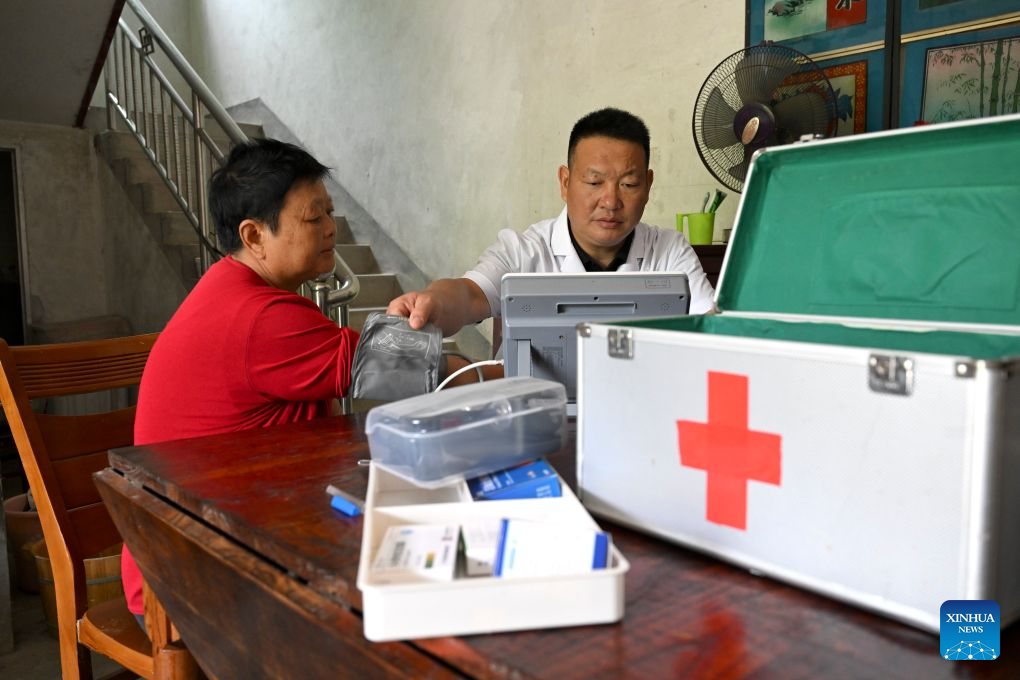
Doctor Yu Jiajun (R) treats villager Wang Jiabi at her home in Qishan Village of Mabu Town, Jinzhai County of Lu'an City, east China's Anhui Province, June 26, 2026. Haidao Village of Qishan Village is located deep in the mountains near the Xianghongdian Reservoir area in Jinzhai County of Lu'an City, east China's Anhui Province. Yu Jiajun, the only village doctor, takes charge of health care for more than 500 villagers there and in the surrounding areas. In the past, there was no clinic. Villagers had to row a boat for two or three hours to go to the health center in the Mabu Town to see the doctor. After graduating from a medical school, following his father's last wishes, Yu Jiajun gave up his job in the city and returned to the village where he was born to work as a village doctor in the year of 2000. In order to visit his patients timely, Yu and his wife set up their home on a wooden boat, named "Haidao Clinic," and provided medical care to villagers on the boat. In recent years, many changes have taken place. The clinic was rebuilt in 2019. With the help of the local government, a standardized diagnosis and treatment building was set up on the shore. Yu's work focus has also shifted from emergency treatment in the past to offering medical service for chronic diseases. However, Yu still need to drive his boat to make visits, as he has been always doing in the past years. Since working as the village doctor, he has changed four boats, conducting more than 20,000 medical consultations at patients' home. Yu joined the Communist Party of China (CPC) in 2014. As a village doctor, he has been fulfilling his own promise to his father and taking the responsibility as a member of the Communist Party. "As long as people need me, I will keep working here," Yu said. (Xinhua/Huang Bohan)

Doctor Yu Jiajun prepares to leave by boat after a home visit in Qishan Village of Mabu Town, Jinzhai County of Lu'an City, east China's Anhui Province, Aug. 4, 2026. Haidao Village of Qishan Village is located deep in the mountains near the Xianghongdian Reservoir area in Jinzhai County of Lu'an City, east China's Anhui Province. Yu Jiajun, the only village doctor, takes charge of health care for more than 500 villagers there and in the surrounding areas. (Xinhua/Zhang Duan)

An aerial drone photo taken on June 26, 2026 shows a view of the Haidao Village in Jinzhai County of Lu'an City, east China's Anhui Province. Haidao Village of Qishan Village is located deep in the mountains near the Xianghongdian Reservoir area in Jinzhai County of Lu'an City, east China's Anhui Province. Yu Jiajun, the only village doctor, takes charge of health care for more than 500 villagers there and in the surrounding areas. (Xinhua/Huang Bohan)

This photo taken on Feb. 16, 2014 shows the "Haidao Clinic" built on a boat in Qishan Village of Mabu Town, Jinzhai County of Lu'an City, east China's Anhui Province. Haidao Village of Qishan Village is located deep in the mountains near the Xianghongdian Reservoir area in Jinzhai County of Lu'an City, east China's Anhui Province. Yu Jiajun, the only village doctor, takes charge of health care for more than 500 villagers there and in the surrounding areas. (Photo by Chen Li/Xinhua)
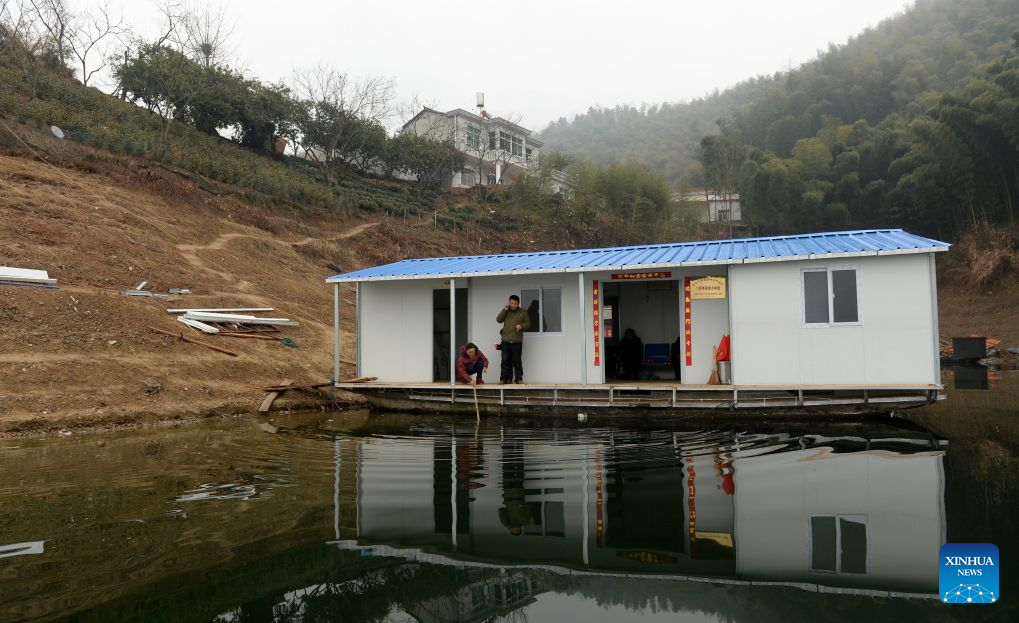
This photo taken on Feb. 16, 2014 shows the "Haidao Clinic" built on a boat in Qishan Village of Mabu Town, Jinzhai County of Lu'an City, east China's Anhui Province. Haidao Village of Qishan Village is located deep in the mountains near the Xianghongdian Reservoir area in Jinzhai County of Lu'an City, east China's Anhui Province. Yu Jiajun, the only village doctor, takes charge of health care for more than 500 villagers there and in the surrounding areas. (Photo by Chen Li/Xinhua)
。

B |

Photo: VCGA 120‑kilogram man lost 20 kilograms on an AI‑devised diet plan, yet the same algorithm, unable to gauge his physiological limits, contributed to multiple organ failures that sent him to the ICU and brought him to the brink of death, domestic media outlet Sichuan Daily reported.
Chen is a 34-year-old content creator whose job requires him to routinely stay up late and maintain a high-fat, high-salt diet. This unhealthy lifestyle pushed his weight up to 120 kilograms, which prompted him to lose weight.
After conducting online research, Chen turned to an AI tool to devise a "scientific" weight-loss plan. The algorithm recommended that he climb stairs for 90 minutes every day and play badminton twice a week, with each session lasting for two to three hours. It even instructed him to keep exercising without pause, even if his clothes were completely soaked in sweat, Sichuan Daily reported.
On the dietary front, the AI‑generated plan prescribed two eggs, half a steamed bun, and a glass of milk for breakfast; 75 grams of beef and 75 grams of vegetables for lunch; and a single serving of yogurt for dinner.
Forty‑five days into the plan, Chen had shed 20 kilograms. Yet after catching a cold, he continued his workouts, a decision that soon landed him in the emergency room. By the time he arrived at the hospital, he had become incoherent and subsequently slipped into a coma, according to the report.
Test results confirmed that Chen was in septic shock, a severe systemic inflammatory response triggered by infection, which subsequently led to multiple organ dysfunction syndrome, Sichuan Daily reported. "Had he been brought in a few hours later, he might have been beyond rescue," the physician said.
Medical intervention pulled him back from the brink. Still, he was baffled as to how a supposedly scientific approach could have nearly cost him his life.
Cao Lianghai, deputy director of the intensive care unit at the treating hospital, said Chen's chronic sleep deprivation had already weakened his immune system's self‑regulating capacity, adding that extreme calorie restriction further suppressed immune function, while excessive high-intensity exercise triggered persistent inflammatory responses, pushing his immune system toward collapse.
The combination of strenuous exercise and fasting led to severe dehydration, which in turn triggered an acute kidney stone attack, said Cao. This caused a blockage and a urinary tract infection, ultimately culminating in a systemic inflammatory response, he added.
"AI can calculate calorie deficits, yet it cannot gauge the true physiological limits of the human body," the doctor warned.
Global Times
。
Current article:http://www.cousizhegaobaolengkuo.bond/list_3j8l2/jatgh9r.htm
Published on:18:46:17


