野兽之道
Y-20B can switch between transport, tanker, other combat roles, PLA documentary reveals_我的网站

A |
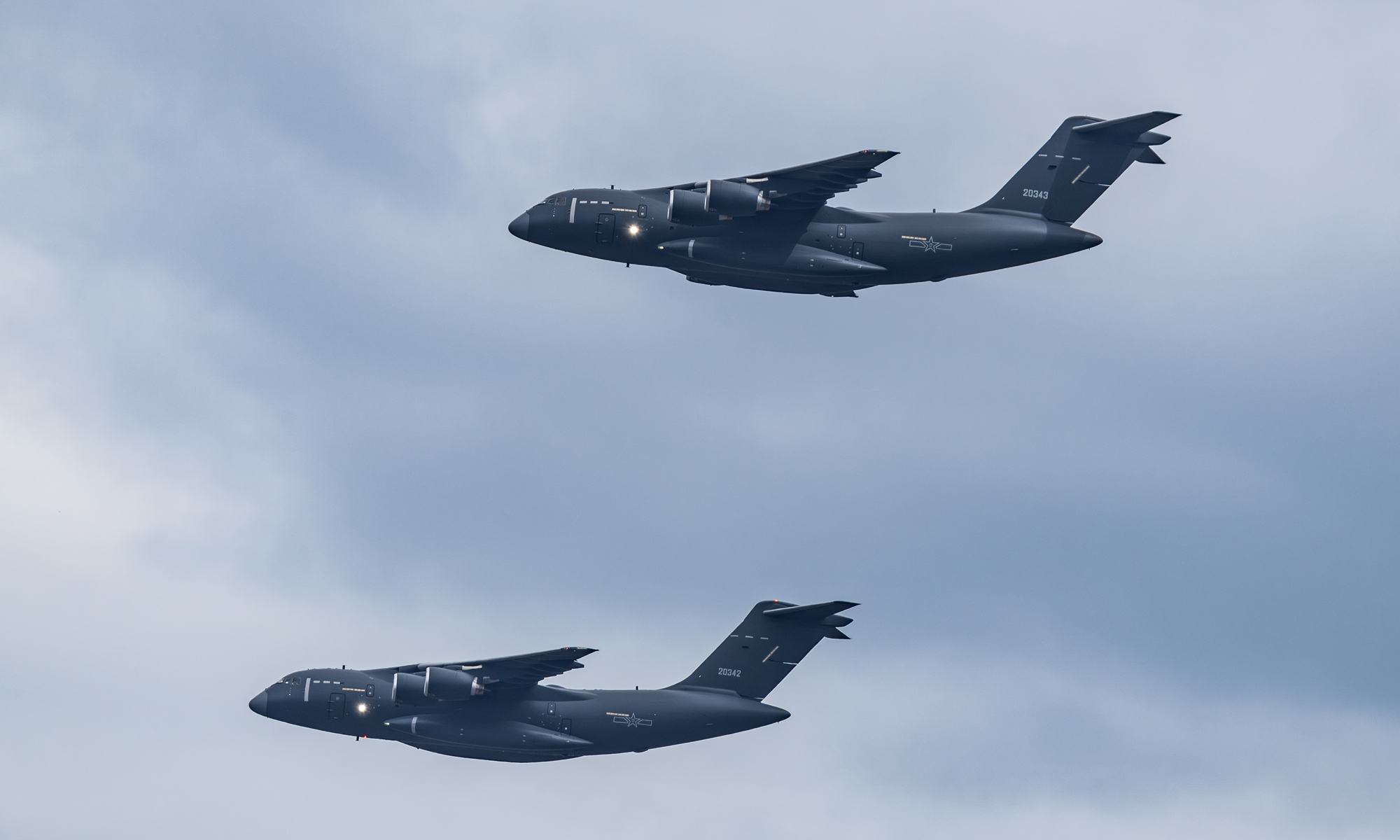
Two Y-20B large transport aircraft fl y in the sky. Photo: VCG
A documentary on the domestically developed Y-20 large transport aircraft family, aired by state media on Wednesday evening, revealed that the Y-20B can switch between transport and aerial refueling functions. A pilot said the aircraft could also take on roles including bomber, early warning aircraft and electronic warfare platform.
With such modifications, the Y-20B platform offers significant advantages in mission flexibility and support capabilities, a military affairs expert told the Global Times.
According to the video released by state broadcaster CCTV News, since the Y-20 was equipped with the domestically developed high-bypass-ratio turbofan WS-20 engine - nicknamed "Chinese heart" - the Y-20B's mission profile has become more flexible. While it is primarily a transport aircraft, it can be quickly converted into an aerial refueling tanker by adding refueling pods and related kits. The line between transport and tanker aircraft is increasingly blurred, and this has significantly expanded the Chinese People's Liberation Army (PLA) Air Force's tanker fleet.
Previously, a promotional video released by China Military Bugle, an official media account affiliated with the PLA news media center, showed that in 2025, the Y-20B was fitted with the WS-20, making it more powerful, more fuel-efficient, longer-ranged and part of a growing family of aircraft.
In the CCTV documentary, Pang Rongqi, a member of an Air Force aviation unit, said: "As a transport aircraft platform, the Y-20 is unique to our country and will play an increasingly important role in the future. The boundaries between transport aircraft and bombers, early warning aircraft, or even electronic warfare aircraft are becoming increasingly blurred. It is possible that all these missions could be accomplished with our transport aircraft platform."
Song Zhongping, a Chinese military affairs expert, told the Global Times on Thursday that the key message from this official release is that the Y-20B is a multi-role platform capable of rapid switching between transport and refueling functions.
The fully domestically developed Y-20B itself is an integrated transport-tanker platform, embodying the concept of a multi-role tanker transport (MRTT). By equipping different functional pods, it can quickly change roles: With refueling pods, it becomes a tanker; with electronic jamming pods, it becomes an electronic warfare platform; with bombing modules, it could potentially perform bombing missions; and with early warning modules, it can serve as an airborne early warning platform, Song said.
It is not uncommon internationally to modify transport aircraft for special roles, including bomber-like missions. In March 2021, the US Air Force converted an MC-130J transport aircraft into a bomber by having it drop a JASSM (Joint Air-to-Surface Standoff Missile) deployment box, according to a Forbes report in May 2021.
Thanks to the Y-20's fully indigenous design, Song said, Chinese engineers have a comprehensive understanding of its aerodynamic configuration, airframe structure, flight control and avionics systems. This means that, as long as the technical conditions are met, modifications can be carried out with greater flexibility and tailored to operational needs. Whether it is a "quick-change" multi-role configuration through pod-based modularization, or deeper modifications, such as installing large radar domes for dedicated early warning aircraft or adding more fuel tanks for dedicated tankers, all can be flexibly achieved.
Song also said that the Y-20B can quickly switch between transport, tanker and electronic warfare roles by mounting different pods, achieving multi-role capability and greatly enhancing the PLA Air Force's mission flexibility and support efficiency.
Its platform potential is vast. It can be deeply modified into dedicated special mission aircraft such as early warning or electronic warfare platforms, filling critical capability gaps in the Air Force. At the same time, it can maintain its basic transport function and, when needed, rapidly transform into other combat platforms through modularization, becoming a true all-rounder.
The core value of this flexibility is that it allows rapid reconfiguration based on wartime mission requirements, while in peacetime it can perform routine transport missions, maximizing equipment effectiveness. The Y-20B's service not only represents a leap in China's strategic projection capability but also provides critical support for the PLA Air Force in building a systematic and diversified air capability, Song noted.
On July 6, 2016, the Y-20, China's domestically developed next-generation large military transport aircraft, officially entered service with PLA Air Force aviation units. A decade later, the Y-20 has evolved from a single transport platform into a family of models including the Y-20A, Y-20B and YU-20 aerial refueling tanker, with its operations extending to more than 40 countries and regions across four continents, according to the Aviation Industry Corporation of China, the aircraft's manufacturer, on its WeChat account in June 2026.
。
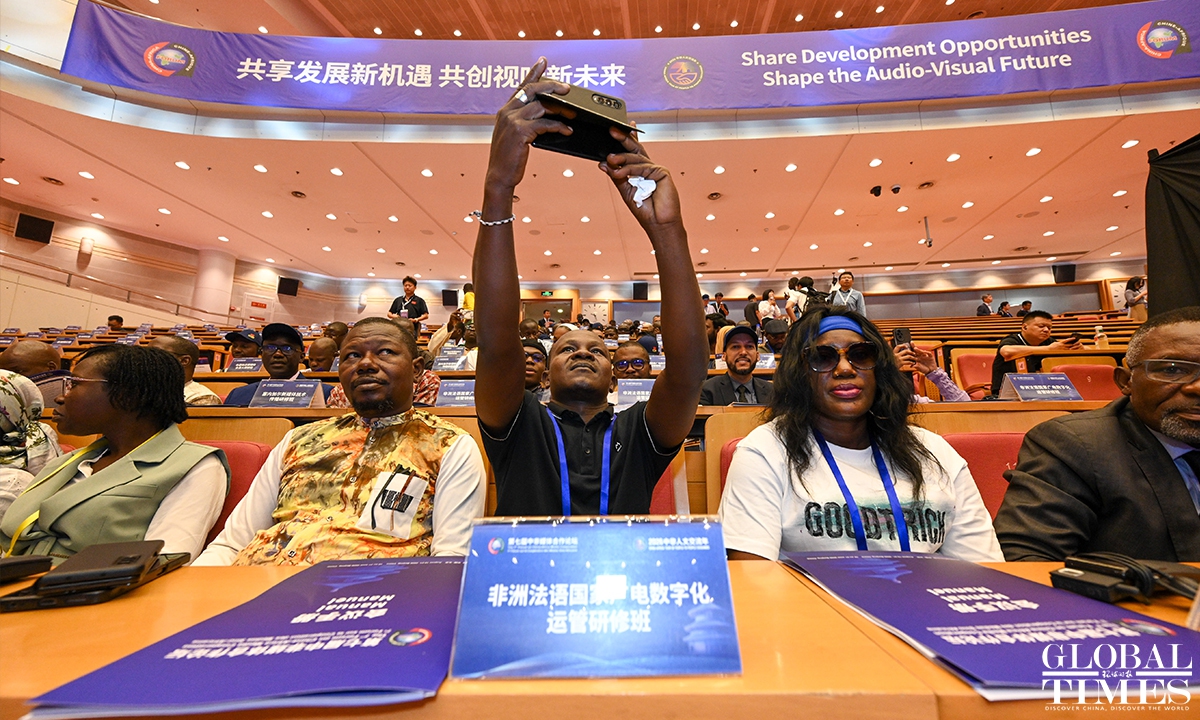
Photo: Chen Tao/GT
Clapping to the beat and humming the famous Chinese folk song "Jasmine Flower," one of the African delegates at the 7th China-Africa Media Cooperation Forum joined Unitree robots in an impromptu joint rendition of the classic Chinese melody, with the robots playing guitar and drums, in Beijing on Thursday.
The lively scene was observed as the 7th China-Africa Media Cooperation Forum officially opened in Beijing on Thursday, with the attendance of 33 minister-level delegates from African countries, marking a record-high level of participation. Participants also released the Joint Declaration of the 7th China-Africa Media Cooperation Forum.
Chinese and African guests held in-depth dialogues on a range of topics, including tech-empowered creative content, trade of audio-visual services, and the application of AI in radio, television and audio-visual sectors.
Gregoire Ndjaka, director general of the African Union of Broadcasting (AUB), said Chinese technology and equipment have made an important contribution to the development and modernization of broadcasting infrastructure in Africa.
He was very happy to confirm that, based on this cooperation, China donated equipment to the AUB Content Exchange Center located in the capital of Albania, and that the AUB has benefited greatly from it, Ndjaka said.
Ndjaka said there are significant opportunities to deepen cooperation, particularly in modern equipment, lightweight production and modern broadcasting systems. The AUB is preparing to establish a training center in Senegal's capital Dakar, which will host a pan-African broadcasting and television station, he noted.
The importance of access to Chinese technology was also highlighted by Mouhamadou El Bachir Diouf, a young participant from Senegal, who tried out Chinese-made VR glasses at the entrance to the forum.
Diouf told the Global Times that his country does not have such equipment and expressed hope that Chinese technologies and equipment could be introduced to Dakar as cooperation between the two sides develops.
Chernor Abduli Bah, Sierra Leone's Minister of Information and Civic Education, said China and Africa, within the framework of South-South cooperation, have a responsibility to ensure that their messages are communicated clearly.
"We are not here in competition with any entity," Bah said, stressing that China and Africa are seeking to foster a multilateral global order based on mutual respect, mutual benefit and the principle that every human being is equal.
He also called for global governance mechanisms to adapt to current realities, saying that the international order cannot simply continue to be defined by a framework established 70 years ago, as it no longer represents the realities and aspirations of many countries.
Whether involving the United Nations, international financial institutions or other global governance mechanisms, the international system should evolve to respond to changing realities, Bah said.
Evelyne Butoyi, Burundi's Minister of Communication and Media, said cooperation with China has brought tangible benefits to the country's broadcasting sector.
She cited a digital terrestrial television project through which Burundi and Chinese firm StarTimes jointly established Burundi Television Company. The project has improved television picture quality and enabled people in Burundi to access a wider range of better-produced programs, she said.
She also highlighted the "Access to Satellite TV for 10,000 African Villages" project carried out with StarTimes, saying that 500 villages in Burundi were included in the project. Set-top boxes were distributed free of charge to rural communities, allowing people in remote areas to watch digital television.
More than 80 Chinese TV series have appeared on African screens over the past two years, including "The Three-Body Problem" and "To the Wonder," according to an introduction at the opening ceremony.
China-Africa mutually beneficial cooperation, however, has drawn criticism from some Western media outlets. A recent New York Times report said that Chinese AI models are widely favored by African developers because they are cheap and freely available, potentially weakening US dominance in the global AI race.
Commenting on the report, Allawi Ssemanda, executive director of Uganda's Development Watch Center, told the Global Times, "The New York Times will always find a way to portray Africa as simply looking for something cheap."
He said African users choose Chinese AI models for reasons beyond cost, including their user-friendliness and the quality of information they provide.
"Personally, I know that if I use an AI model developed in the US, it may be good, but it may not give me the facts I am looking for because of global politics. If you use a Chinese-developed model, you can get what you want."
Ssemanda also rejected the notion that the affordability of Chinese AI should be viewed as a weakness. China, as part of the Global South, understands that making AI prohibitively expensive would limit access for developing countries, he said.
His comments point to a broader concern among African countries: for many developing nations, the question is not which country dominates the global AI race, but whether technological advances can be made accessible and translated into tangible development opportunities.
Thierry Lézin Moungalla, Minister of Communication and Media and government spokesperson of the Republic of the Congo, echoed this point, saying African countries continue to grapple with the digital divide.
"However, we can believe in the friendship, support and practical cooperation offered by China," Moungalla said.
。
Current article:http://www.cousizhegaobaolengkuo.bond/list_iohm/ix7.html
Published on:05:10:30


