


驱动精灵
Defiant Taiwan moving away from China_我的网站

一 |
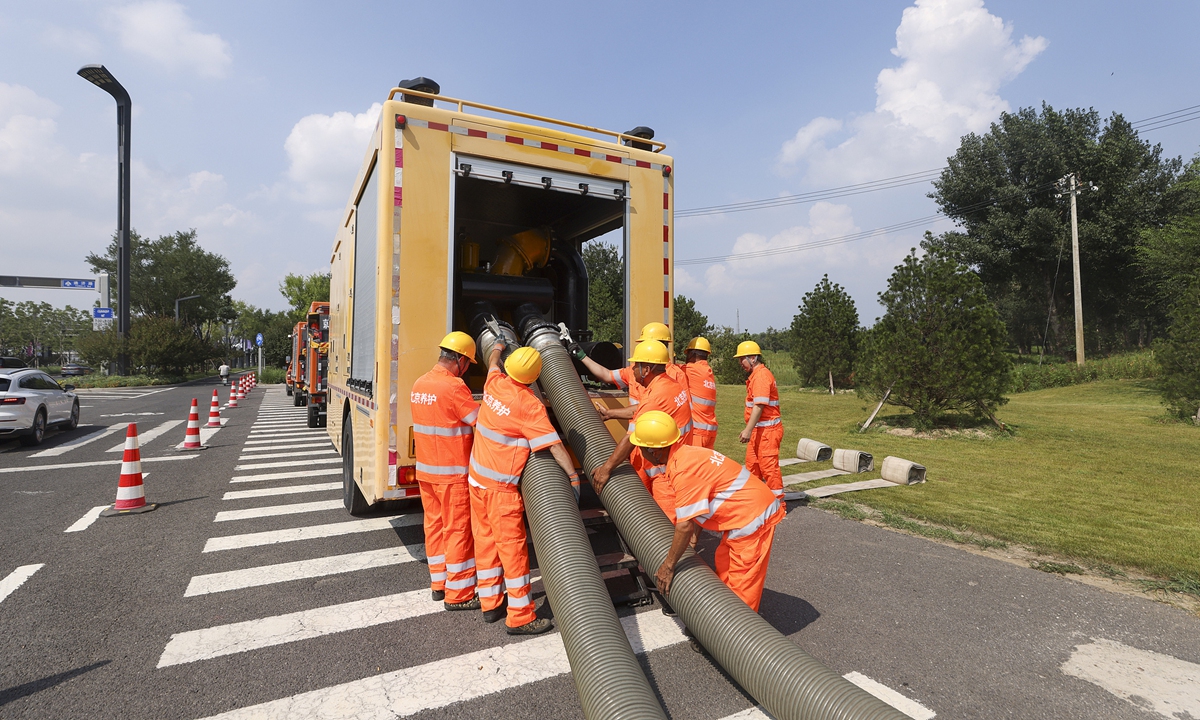
Beijing activated a Level II flood-control emergency response, the second-highest level, on Tuesday as authorities warned of heavy rain and heightened risks of urban waterlogging and landslides.
Most parts of the city are expected to receive more than 100 millimeters of rain within six hours and over 150 millimeters within 24 hours from Tuesday evening through Thursday, according to the Beijing meteorological service.
Beijing issued an orange alert for rainstorms at 10 a.m. Monday, while several districts, including Fangshan, Daxing and Tongzhou, issued the highest-level red alerts.
Authorities said residents in high-risk areas would be evacuated by Tuesday evening. Construction work will be suspended, and mountain campsites and scenic areas will be closed.
Starting Wednesday, employers are encouraged to adopt flexible working hours or staggered schedules. Schools may suspend classes and in-person training depending on conditions, while organized outdoor sports activities will be halted.
Beijing's drainage authorities have put 252 flood-control teams on standby. Preparations, including the installation of flood barriers, have also been stepped up at 368 subway stations, 33 hospital campuses and 17 elderly care facilities.
In Fangshan, where exceptionally heavy rain is forecast, authorities have begun evacuating residents from high-risk areas ahead of the downpours and deployed emergency rescue teams and supplies, with more than 150,000 items of emergency equipment and materials on standby.
Dolphin, the 13th typhoon of the year, made two landfalls in Zhejiang Province on Sunday. The National Meteorological Center on Tuesday maintained an orange alert for rainstorms, forecasting heavy rain across a broad swath of the country through Wednesday afternoon, including Zhejiang, Shanghai, Shandong, Beijing and Tianjin.
As of 7 a.m. Monday, about 167,900 people had been moved from vulnerable areas on land and at sea in Fujian Province. By late Sunday, Shanghai had evacuated around 215,600 people from areas considered at risk.
。

二 | Taipei, Oct 10 (UNI) Taiwan on Monday marked the "Double Ten" or 10 October, the self-ruled island's national day.
The annual celebration is especially significant this year -- tensions with Beijing, which claims Taiwan as its territory, are at an all-time high, reports BBC.
China's leader Xi Jinping, who has been particularly vocal about "re-unification", is set to get a third term at a historic Communist Party meeting next week.
Ironically, 10 October has nothing to do with Taiwan or any moment in its history. It, in fact, marks the day in 1911 when an uprising began in Wuchang in central China that eventually led to the collapse of the last imperial dynasty -- and the establishment of the Republic of China.
So why is Taiwan celebrating the day? Because the island's official name is still The Republic of China on Taiwan. The flags flying across Taipei today are still of the white star on a blue and red background.
It is a peculiar legacy of the Chinese civil war. In 1949, the defeated nationalist regime of Chiang Kai-shek fled across the Taiwan strait to Taipei. For decades Chiang held Taiwan in an iron grip, while continuing to proclaim his regime "the true democratic government of Free China", the BBC reported.
Today all of this seems slightly absurd -- and for so many Taiwanese, especially the younger generation, it is.
Opinion polls this year suggest that 70to 80 per cent of people here now consider themselves "Taiwanese". That is a significant increase from a decade ago, when around half the population still said they were "Chinese".
This trend has not gone unnoticed in Beijing, and it is retaliating, the report said.
Around half of the island's population now supports formal independence, even under threat of attack from China. A poll last year showed 75 per cent of Taiwanese say they would fight a Chinese invasion.
UNI MR。
Current article:http://www.cousizhegaobaolengkuo.bond/nq6/2y2.docx
Published on:05:43:34