国光帮帮忙
Dhanush and Kriti Sanon’s Tere Ishk Mein enters the 100-crore club_我的网站

一 | Dhanush and Kriti Sanon’s latest romantic drama, Tere Ishk Mein, has officially entered the Rs 100 crore worldwide club within just six days of release. Directed by Aanand L Rai, the film continued its impressive run even as it saw its sharpest weekday dip on Wednesday. Early estimates from Sacnilk suggest that the film collected around Rs 6.75 crore net on Day 6, with the Hindi market contributing a substantial Rs 6.4 crore and Tamil markets adding approximately Rs 35 lakh.
While Wednesday marked the lowest single-day collection so far, the overall box office performance remains strong. Major metro regions such as Mumbai, Delhi-NCR and Bengaluru are still registering steady footfalls, and mass circuits have maintained consistent numbers through the week.
The film opened to an estimated Rs 16 crore on Friday, followed by an even stronger surge over the weekend—Rs 17 crore on Saturday and a peak of Rs 19 crore on Sunday. Monday brought a predictable 50% decline with Rs 8.75 crore, but the film bounced back to Rs 10.25 crore on Tuesday. With Wednesday’s earnings added, Tere Ishk Mein stands at roughly Rs 76.75 crore net in India and around Rs 92.5 crore gross domestically.
The film’s overseas contribution of about Rs 8 crore pushed its worldwide gross beyond Rs 100 crore, marking a personal milestone for both leads. For Dhanush, it is now his highest-earning Bollywood film and his first Hindi project to cross Rs 100 crore globally. For Kriti Sanon, it becomes her seventh film to join the coveted club.
View this post on Instagram
A post shared by Aanand L Rai (@aanandlrai)
In interviews, Dhanush described his character Shankar as someone easy to root for but layered with challenges that demanded creative effort. He shared that he gravitates toward roles that push him artistically, calling this one “a good part with a lot of challenge.”
As Tere Ishk Mein enters its second week, it faces fresh competition from Dhurandhar. Both films, however, have limited time at the box office before James Cameron’s highly anticipated Avatar: Fire and Ash arrives on December 19, a release expected to dominate screens nationwide.Also Read: Tere Ishq Mein Box Office Day 2: Dhanush’s Film Crosses 30 Crore in Two Days。
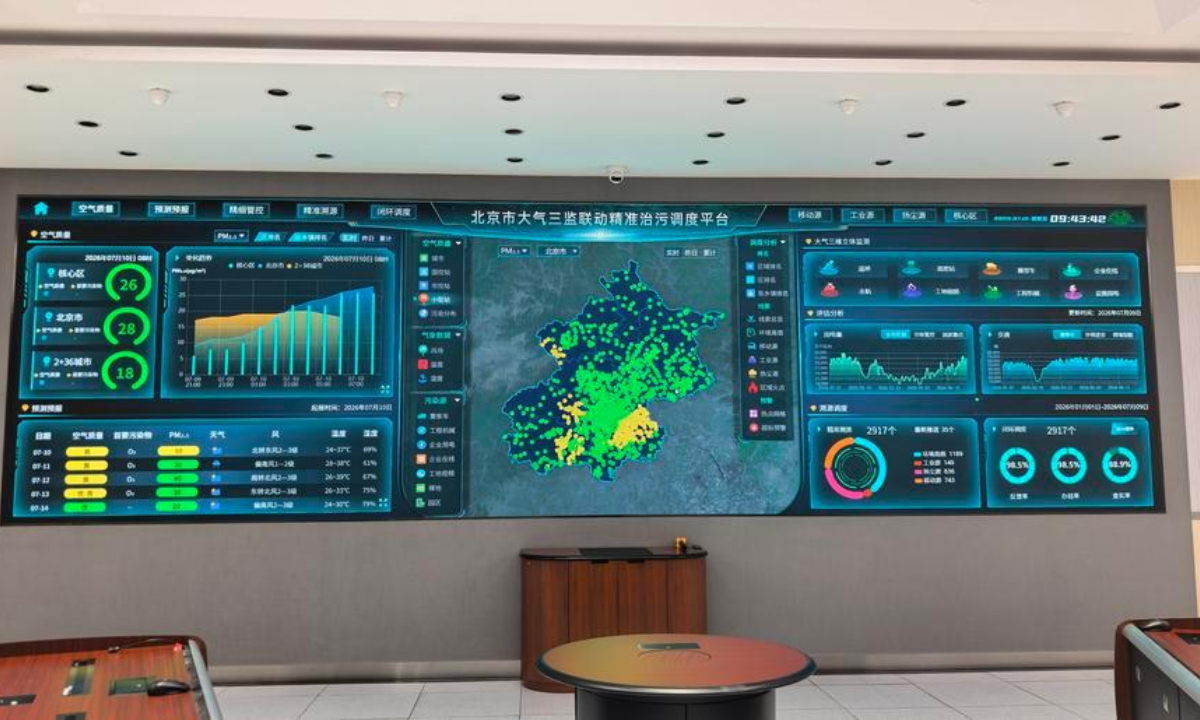
This photo taken on July 10, 2026 shows a data-driven environmental governance system, known as the innovative regulation-monitoring-inspection linkage model, showcased at the Beijing Municipal Ecological and Environmental Monitoring Center in Beijing, capital of China. (Xinhua/Sun Suying)Beijing's blue skies have become a visible sign of the city's progress in tackling air pollution, and behind that progress, digital technologies are playing an increasingly important role.
In 2025, Beijing recorded 311 days with good air quality and only one heavily polluted day, compared with 58 heavily polluted days in 2013, when the city officially began releasing PM2.5 monitoring data. The annual average PM2.5 concentration, a key indicator of air quality, fell from 89.5 micrograms per cubic meter in 2013 to 27 micrograms per cubic meter in 2025, a decline of nearly 70 percent.
The progress has drawn international attention. The United Nations Environment Programme has highlighted Beijing's experience in improving air quality as a model for other cities.
According to experts at the Beijing Municipal Ecological and Environmental Monitoring Center, the cleaner air is the result of a comprehensive system integrating environmental monitoring, scientific analysis, policymaking, regional cooperation and law enforcement -- with digital technologies now woven into every link of that chain.
MORE TARGETED APPROACH
Effective governance begins with accurate monitoring. Beijing has established a multi-level air-quality monitoring network. Figures show 35 standard monitoring stations across the city continuously measure six major pollutants, while more than 1,000 compact sensors deployed across communities and townships provide more detailed information on local air-quality variations.
The monitoring system was gradually built by the Beijing Municipal Ecological and Environmental Monitoring Center, one of China's earliest ecological and environmental monitoring institutions, responsible for monitoring Beijing's air, water, noise, soil environments and ecosystems.
The center has developed an analytical system that can identify around 125 components of PM2.5, covering most of its composition and helping researchers trace pollution sources.
"Source analysis helps us identify the major contributors to pollution at different stages, providing a scientific basis for policymakers to target key emission sources," said Li Yunting, technical director at the center.
Coordinated by the Beijing Municipal Ecology and Environment Bureau, the center has conducted four rounds of PM2.5 source analysis studies with other institutions, with results released in 2014, 2018, 2021 and 2025.
The latest analysis showed that regional transport contributed 57 percent of Beijing's PM2.5 pollution. Among local sources that accounted for the remaining 43 percent, vehicle emissions and residential sources represented the largest share of pollution, a distinctive characteristic of a major international metropolis.
The monitoring results have provided scientific support for a series of pollution-control measures. For example, Beijing has promoted new-energy vehicles to reduce transport emissions and adopted advanced techniques, including air-supported membrane structures, to control dust emissions. Meanwhile, coal combustion pollution, once a major contributor, has almost been eliminated and is no longer listed among the main sources, reflecting broader national efforts to reduce coal consumption, promote clean energy and upgrade heavily polluting industries.
With PM2.5 concentrations now at relatively low levels, further gains in air quality will depend on more targeted, science-driven approaches.
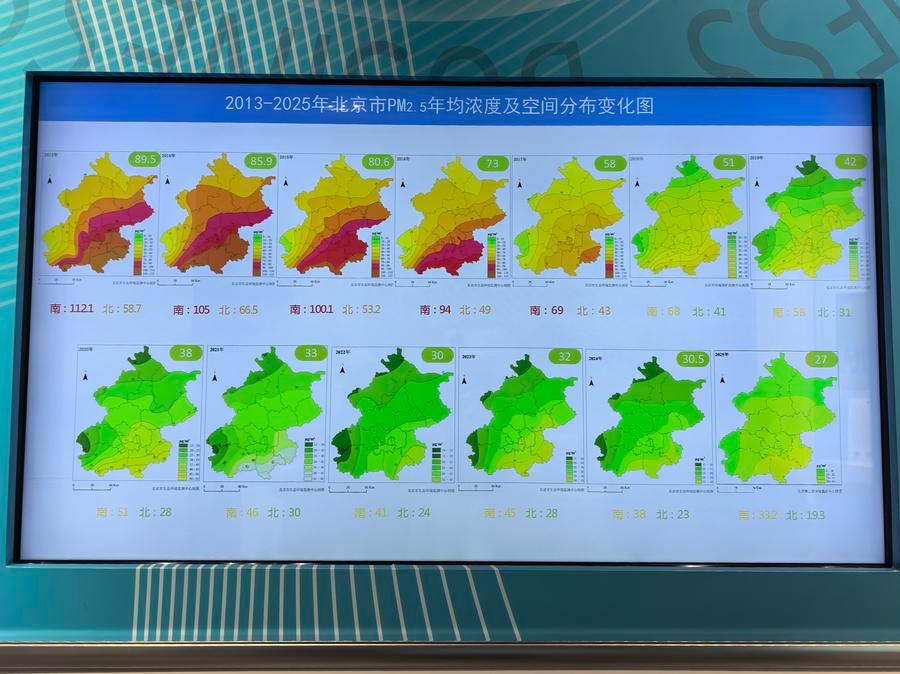
This photo taken on July 10, 2026 at the Beijing Municipal Ecological and Environmental Monitoring Center in Beijing, capital of China, shows the changes in the annual average concentration and spatial distribution of PM2.5 in Beijing from 2013 to 2025. (Xinhua/Sun Suying)
SMARTER ENVIRONMENTAL GOVERNANCE
Beyond monitoring pollution, Beijing has built a data-driven environmental governance system that links monitoring, regulation and enforcement in a closed loop from detection to action and follow-up evaluation.
Developed by the center and known as the innovative regulation-monitoring-inspection linkage model, the system integrates artificial intelligence, the Internet of Things, satellite remote sensing and vehicle-mounted monitoring technologies to pull together environmental data from multiple sources onto a unified platform.
"The system brings information that was once scattered across different departments onto a single platform," said Zhang Likun, director of the smart system division at the center, adding that this enables off-site enforcement and joint cross-sector actions involving housing, water resources and transportation, significantly improving the efficiency and precision of environmental management.
Using more than 30 intelligent algorithms, the platform automatically analyzes data and identifies potential pollution risks, based on which monitoring staff identify the most pressing problems and forward them to enforcement departments.
The approach has already drawn international attention. Clean Air Asia, an international nongovernmental organization focused on improving air quality across Asia, featured the system as a representative case study in its "China Air 2025" report. The model was also presented at the 2026 Better Air Quality Conference and recognized with the Certificate for Clean Air Best Practice Sharing.
China has integrated ecological conservation into its modernization drive. As the country speeds up efforts under the Beautiful China Initiative, Beijing's experience demonstrates how technology can support more precise, coordinated and sustainable environmental governance.
。

二 |
Current article:http://www.cousizhegaobaolengkuo.bond/uyw/quk.doc
Published on:12:43:41

